SIMONE BERNO
Born in Padova, Italy, in 1975
Born in Padua in 1975
“I belong to a world that is present, future, and past,
in which I search for a meaning to life.
I feel nostalgia for what I have never known,
for the memories that bind me to a past not my own,
for the impossibility of return.”


NINETIES
In the 1990s, during his formative years, he developed a deep interest in drawing.
He began to shape a personal graphic language, poised between surrealist suggestions and cubist structures.
Drawing soon became a constant presence in his work, an alter ego of his material practice and a tool for poetic thought, even before being a means of graphic representation.
This body of work has often been used in performances and street art interventions.
The artist continues to work in this field to this day.
In the early 2000s, he began a research path focused on the use and assembly of noble materials such as steel, copper, and brass. The first material works date back to this period. From the very beginning, the working process has been entirely manual.
Berno uses sheets marked by time, naturally oxidized, intervening with cuts, folds, perforations, and tears that generate forms born directly from the material.
The reclaimed material is adapted and transformed, bent to an expressive necessity that does not impose a form, but allows it to emerge.


Most of the materials come from abandoned places such as derelict houses, disused factories, and forgotten urban spaces. Some materials are recovered by chance, others are deliberately sought out and planned.
Each surface carries a preexisting history that becomes part of the work, adding an additional layer of meaning.
Over time, oxidation has become a recognizable hallmark of his practice.
Surfaces meant to be observed and touched, capable of evoking a nostalgia that does not necessarily belong to direct experience.
The works suggest un-lived memories, a bond with a past that is foreign yet familiar, a melancholy tied to the impossibility of return.
Time is not only a theme, but an active part of the creative process, stratified within the material itself.
Over the years, he has developed a series of material works in bas-relief and high relief.
These are assemblages of oxidized materials that result in surfaces reconnected to a precise vision.
The works, similar in form and scale, address human virtues and fragilities, placed within a suspended timeline. The processes involved are physically complex, ranging from polishing to the carbonization of sulfur.
The coloration of the surfaces is not forced, but integrates the preexisting oxidations.
The meaning of the work is often concealed within the poetic title, which expands its narrative.
Chromatic harmony and the logic of assembly convey a visible delicacy, matured through the physical effort of construction and remaining perceptible in the material that composes the work.
THE POETIC HOTEL

“If, in the summer of 2019, when I first crossed the threshold of the Albergo da Marco, someone had told me that I would one day find myself writing the preface to the book that tells this story, I would have smiled, probably thinking my interlocutor was crazy.”
“At that time I was looking for a studio where I could work on my sculptures and that could also serve as a small exhibition space.
It was through a fortunate coincidence that I learned of a rentable space in a hotel in Padua that had been closed since 1997.”
“The idea of bringing my works, by their very nature so closely tied to the past and to the concept of Time, into an abandoned place immediately fascinated me; and of being the one to reopen the hotel after twenty-two years.
Within a few days I reached an agreement with the owner of the building and scheduled the transfer of the works for the following weeks.”
“Of course, there was some restoration work to be done, but the street-facing display window was perfectly suited to my purpose, and there was even a room at the back, probably the old inn kitchen, which seemed ideal as a workshop. I did not yet know, in that sweltering Paduan summer, how much my plans would be overturned by the hotel itself.”
Everything began with a white sheet covering the display window during the days of restoration.
“I was working alone, in the heat of July, and partly as a joke I had left a small hole through which one could peek inside.
While arranging and cleaning the spaces, I found, stored away in the various rooms on the ground floor, many old pieces of furniture, paintings, ornaments, the guest register, the lamps.”

“For the residents of the neighborhood, accustomed to seeing the hotel closed and deserted for more than two decades, the curiosity and amazement at seeing the interior again, with the old counter, the pigeonholes, and the armchairs returned to their place, sparked word of mouth that amplified within me the idea that was gradually taking shape: to transform that abandoned place into a place for Art, outside established conventions.
This was followed by an article in a daily newspaper, the first messages requesting information, and proposals for collaboration from numerous artists.”
“Thus, in a short time, with the old furniture returned to its place, that display window once again came to resemble the lobby of the small hotel on the outskirts, known in the city since the 1950s.
Something peculiar was happening in those days: every morning, before getting to work, I would count the round marks left on the glass by the tips of the noses of the many passersby who leaned in toward the window.”
“For six months, the hotel became a place of gathering and creative ferment.”
FORGE OF IDEAS AND CREATIVITY THAT GAVE LIFE TO THE POETIC HOTEL

The project:
At the Poetic Hotel, the rooms, left exactly as they were found, in their state of decay and abandonment, became the ideal stage for an intense artistic activity that took shape through installations, paintings, sculptures, photographs, poems, performances, and other forms of artistic and poetic expression.
The twenty-five artists, “guests” of the hotel, interacted by drawing from the suggestions of the place and by each reworking their own vision of the hotel, in its abandonment and in the suspension of time between the then and the present, giving new life to the fabric of history and suspended time they found in their hands.

Once the interior spaces and rooms had been redefined, and the installations and performances completed, the Check-Out took place on December 13, 2019, an event that celebrated the definitive detachment of the authors from their works.
The rooms on the upper floors of the hotel have been inaccessible ever since.

The installations, left behind inside the hotel and entrusted to the inexorable wear of Time, can no longer be visited in person, but only glimpsed through digital media and the powerful force of imagination, since the Poetic Hotel is a place deliberately closed to the public by the very nature of the project and by the statute signed by all the artists.
When the building is demolished, the entire collection of works will be destroyed along with it. Only then will those who wish be invited to recover their remains from the rubble.
The Poetic Hotel represents a point of convergence between all the artist’s forms of expression and virtually unites the oxidations generated by time in his material works with the stylistic signature of his performances, integrating within it works and graphics of a surreal and dreamlike character created directly in the rooms.

The Poetic Hotel project has received attention from several national and international outlets, with articles in daily newspapers, specialized magazines, and television coverage.
Today, the hotel is also home to the artist’s studio, which remains accessible only on the ground floor, at the rear of the building.
A publication containing a novel set inside the hotel in the late 1990s is currently in print.
MURALES

Over the years, Berno has also carried out street art interventions and murals.
Few in number but easily recognizable, they are mainly located in Padua, his hometown.
This activity sees new project developments in 2025.


S/HE GENERATION IS
MOTHER EARTH AND FATHER
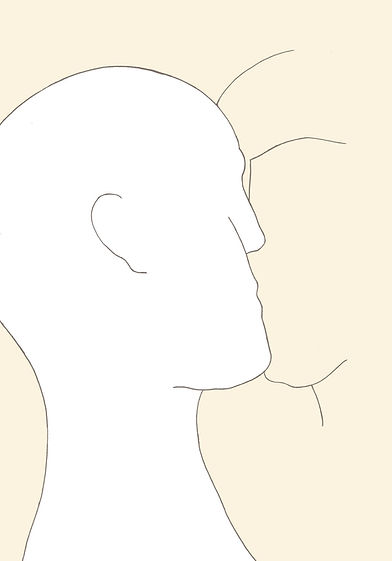
S/He Generation is a graphic and communication project that originates from an essential sign: a breast and a leaf.
Two primary elements, immediately recognizable, that function as archetypes rather than narrative images.
The breast represents the mother as the origin of life, a place of nourishment and transmission.
The leaf represents Mother Nature, source, breath, and support of every living being.
S/HE GENERATION
The body as a place of relationship.
The breast as a vital function, not as identity.
Together, breast and leaf build a minimal visual language that speaks of life as relationship.
In this project, the breast is neither female nor male.
It is a primordial symbol of nourishment, detached from any sexual or identity-based reading.
It is life itself that generates, welcomes, and transmits itself through every form and existence.
When the project states S/He Generation is Mother Earth and Father, it introduces a symbolic figure that goes beyond gender division. S/he is not only woman, mother, or daughter. It is also father, son, a voice that moves through and unites generations.
S/He does not define an identity, but a principle: continuity, responsibility, care.
Cycle, transformation, passage between generations.
The minimal gesture of contact implies responsibility.
Protection is another central theme of the project.
Not as defense or closure, but as a space of care that allows life to exist and transform.
To protect means to create the conditions for something to grow.


Life as an act of trust in the void, in living the fall as the beginning of rebirth.
Time is not linear, but cyclical. The fall is not loss, but passage.
Transmission takes place through small, repeated gestures, often invisible.
Every gesture leaves a trace.
Every drop is memory.
Audience interaction is an integral part of the work.
S/He Generation launches a sign, but its meaning remains open, entrusted to the experience, sensitivity, and history of those who look.
Theme and discussion emerge through dialogue, not assertion.
S/He Generation is born as a shared space for reflection on empathy, difference, and relationship.
It does not speak of identities to defend, but of bonds to recognize.
It is a project that moves between graphic design, visual art, and symbolic communication.
ART TO BE STOLEN
Small-format graphic works are also used in urban art actions defined as “abandonment.”
Berno was among the most active members of the Roman collective Arte da Rubare, a project of artistic sharing in urban space, also covered by Rai Costume e Società.
The works, authenticated and numbered prints, are left near monuments or symbolic places in the cities the artist passes through.
Through his own channels, Berno tells the story of the place where the work is left.
Those who find it can take it with them and, through the work, trace back to the memory of the site.
Over time, these works have been “abandoned” on every continent and are now found in the homes of people who encountered them by chance in Europe, Canada, the United States, Africa, and Australia.


PERFORMANCE IKEA
Emblematic of his research, this action is able to summarize the artist’s stylistic signature.
After regularly purchasing several frames, Berno replaces the descriptive sheets with authenticated original prints, attaching the receipt to the back as proof of purchase.
The packages are carefully resealed, with no visible signs of tampering, and placed back on the shelves.
Customers who pick up the frames, finding them already paid for, attempt to leave the store, triggering the checkout blockade and the intervention of the staff.
The works are withheld, despite the regular purchase.
The action creates a short circuit in the system, shifting the responsibility for the removal onto the retail point itself. The works are never recovered.
A silent and finely provocative performance.


METABOX
Berno has been an active member of the project Metabox Sensibilità aumentata since 2019.
METABOX is a dynamic online installation of contemporary art.
An emotional flow guided by the sensibility of the authors who, through their artistic practices and individual characteristics, narrate how sensitivity transforms and evolves in the age of connection.
An increased sensitivity, precisely.

In 2023 and 2025, Berno was selected as an artist for the CHEAP Festival, and his works were displayed within the circuit of posters installed throughout the city of Bologna.
CHEAP is a public art project founded by six women in Bologna in 2013.
It is a project that intervenes primarily in the urban landscape, focuses on contemporary languages, and is engaged in the search for a balance between curatorial practice and activism.

CHEAP FESTIVAL
Berno maintains a consistent graphic production.
The drawings, situated between Cubism and Surrealism, testify to a coherent versatility across different creative directions.
Despite the use of different media, the mark always remains traceable to the same hand.
The lithographs are produced as unique pieces or in extremely limited editions, in contrast with the serial nature of the technique, reaffirming the concept of the artwork’s uniqueness.
LITHOGRAPHS


ALTER EGO VIOLA BIANCO
Viola Bianco is the name under which Berno signs the works he himself describes as the style of the early stages of his path.
Chaotic and surreal drawings that develop around an initial concept or thought.
The title of the work becomes a key to interpretation, usually traceable in a hidden detail within the piece.
Rare and seldom used in the artist’s public narrative, the works of Viola Bianco nevertheless remain central and decisive in the formation of his figurative language.


NEXT EVENTS
OXIDUM
Solo Exhibition
Padova – Galleria Cavour
2026.06.05 – 2026.07.05
Solo exhibition.
A body of works that engages with time, matter, and oxidation as a vital and irreversible process.
Surrealism enters as an element of rupture with reality and linear time, opening onto suspended and misaligned visions, where matter ceases to obey the logic of functional use and becomes imagination.
An intimate and silent atmosphere, crossed by references to the Poetic Hotel.